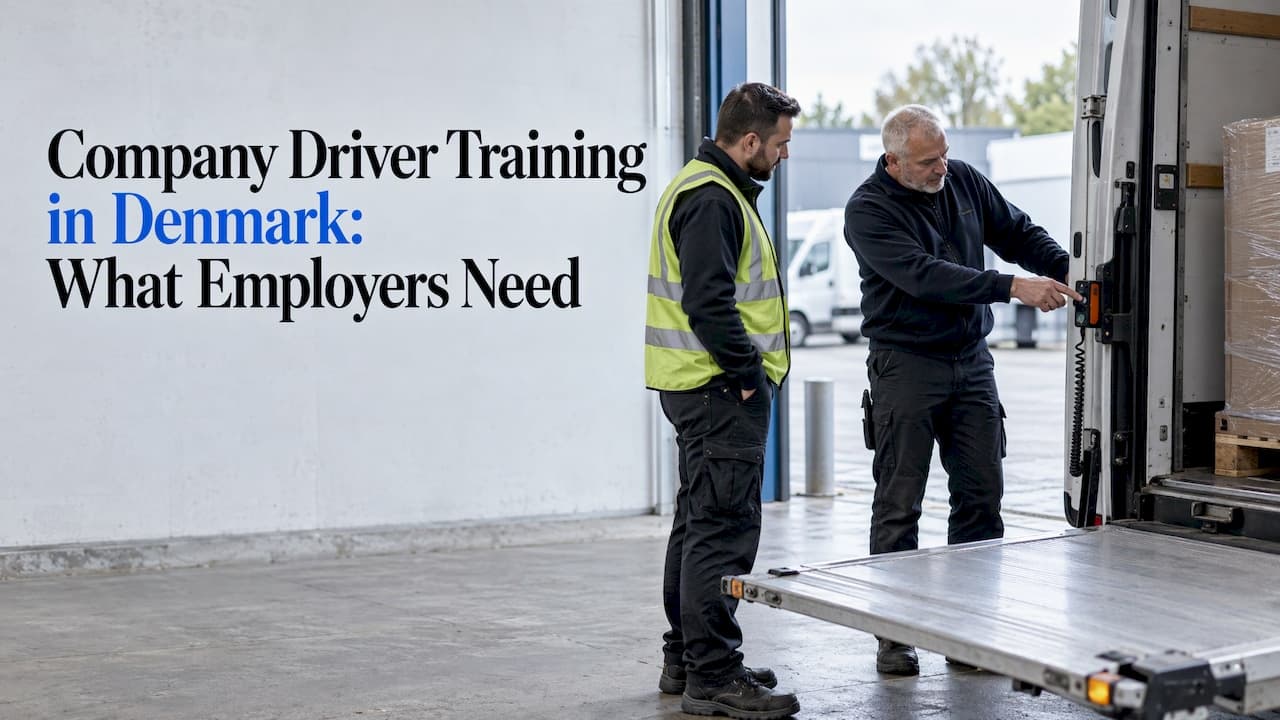
Company driver training means giving everyone who drives for your business the instruction, qualifications and follow-up their job requires. In Denmark that has two layers: the employer's general duty to provide training and supervision, and the formal qualification courses that apply to professional truck, bus and van drivers. This guide shows how to sort your drivers into the right group, pick the right training, and pay for it.
TL;DR
- Danish employers must make sure employees get sufficient training, instruction and supervision for the actual task, and that includes driving.
- Professional drivers often need a formal qualification (initial course, then periodic training every five years). Which one depends on vehicle type and when the licence was issued.
- Assess needs per driver: task, risks, experience and prerequisites. A single induction day is rarely enough.
- Funding such as AMU course fees, VEU compensation and industry funds may reduce the cost. Check eligibility before you book.
- We at Votra Danmark offer van and truck haulier courses and van driver qualification and refresher courses. Our business arm can handle the paperwork around your fleet.
Table of Contents
- What company driver training actually covers
- Your legal responsibility as an employer
- Which of your drivers need a formal qualification
- How to assess what each driver needs
- Formats for training a group of employees
- What it costs and how to get support
- A simple six-step plan for your company
- Perspective: why we build training around Danish requirements
- Training from Votra
- FAQ
- Sources
What company driver training actually covers
There are two things people mean by the phrase, and mixing them up causes most of the confusion.
Formal qualification training. These are regulated courses a professional driver must hold to work legally in certain roles: commercial van, truck, bus and taxi work. They end in an exam or a recognized certificate.
Company-specific instruction. This is what you teach your own drivers about your vehicles, routes, loading methods, customers and rules. Danish guidance says training should fit the work task and address its risks, including instruction in the equipment and methods used. A driver can hold every certificate and still need an hour on your tail-lift or your delivery procedure.

A good training plan for a transport company combines both. The certificate proves legal competence. The internal instruction makes the driver safe and efficient in your operation.
Typical topics
- Safe driving, speed and following distance
- Load securing and handling of goods
- Driving and rest time rules and use of the tachograph
- Vehicle checks before departure
- Customer handling and delivery routines
- Passenger assistance, if you carry people (for example flex traffic work)
- Emergency procedures and incident reporting
Some training providers use theory plus practical exercises in an advanced truck simulator, as one Danish haulier describes in its driver certification program. Simulators let drivers practice situations that are risky or rare on the road.
Your legal responsibility as an employer
Under Danish rules, you must ensure employees receive adequate training, instruction and supervision so they can work safely and healthily. This applies to driving duties as much as to any other task. Three practical points follow:
- Training is tied to the person. Drivers may need training suited to their skills and work situation, so a new hire with ten years of experience and an apprentice need different programs.
- Supervision counts. Instruction is not a one-off event. You are expected to follow up on how the work is done.
- Document it. Keep a record of who was trained in what and when. It helps you spot expiring certificates and shows that you took the duty seriously.
For questions about how the rules apply to your specific operation, the Danish Working Environment Authority (Arbejdstilsynet) is the body to ask.
Which of your drivers need a formal qualification
The rules depend on vehicle type and when the driver got the licence. According to the transport industry's training body, bus drivers licensed after 10 September 2008 and truck drivers licensed after 10 September 2009 need qualification training for commercial driving. The same source says van drivers licensed after 30 June 2019 need a three-day commercial van qualification.
| Driver type | What the qualification looks like | Where to start |
|---|---|---|
| Commercial van driver (licensed after 30 June 2019) | Three-day qualification, then periodic refresher | Van driver qualification (VB GU) |
| Van driver who needs the refresher | Periodic training to keep the qualification current | Van driver refresher course (VB EU) |
| Truck driver | Initial qualification, then periodic training | See the industry body's course overview |
| Bus driver | Initial qualification, then periodic training | See the industry body's course overview |
| Taxi driver | Dedicated taxi training | Taxi driver training in Denmark (Danish required) |
For trucks, initial qualification can be taken as an 8-week basic course or a 4-week intensive course, depending on age and type of driving. Professional drivers must then complete mandatory EU periodic training every five years to keep the qualification and their safety knowledge up to date.
A practical tip: build a simple spreadsheet with each driver's licence date, vehicle category, qualification date and next renewal. Renewal dates sneak up on companies that rely on memory. If tracking deadlines is a burden, our Business services include monitoring of driver documents and deadlines as part of administrative fleet management.
How to assess what each driver needs
A training needs assessment does not have to be a big project. Danish guidance says needs depend on the specific task and situation, the risks, and the employee's skills, experience and prerequisites, as set out in the official instruction and supervision rules. Turn that into five questions per driver:
- What vehicle and what kind of work does this person do (distribution, long haul, passengers, special equipment)?
- Which legal qualification does that role require, and is it valid and in date?
- What are the biggest risks in this role: tight city delivery, night driving, heavy loads, vulnerable passengers?
- What experience does the driver bring, and where have you seen incidents, damage or near misses?
- Does the person speak and read enough Danish to follow the training and your procedures? If not, which language of instruction do they need?
Answering these gives you three lists: legal must-haves, company-specific instruction, and development training such as digital skills.
Refreshers beat one-off induction
Safety research notes that habitual poor driving behavior is hard to change, which makes regular refresher training more valuable than a single induction. The same research suggests that involving senior, experienced drivers as trainers can increase acceptance among professionals who are skeptical of outside instruction. In practice: let your most respected driver run the demonstration on your own vehicles, and combine it with a formal course.

Structured records in demanding sectors
In specialized fields such as chemical transport, training is managed through audits that require structured training records and behavior-based safety programs. Even if your customers do not demand it, the discipline of recording training pays off.
Formats for training a group of employees
You have several options, and most companies mix them:
- Classroom courses. Good for qualification training, where an instructor and a group work through theory and practice.
- Online self-study with an exam. Useful for shift workers who cannot be away for several days in a row. At Votra, we offer online self-paced study options with live exam slots and digital certificates for selected courses.
- Blended programs. Theory online, practical elements in person.
- In-house instruction. Your own vehicles, routes and procedures, led by an experienced colleague.
- Language options. Our courses are available in multiple languages, which matters when your workforce is international. Note that the taxi training requires Danish.
Group booking has a practical advantage: the whole team takes the same course at the same time, which makes planning rosters easier and builds a shared standard.
What it costs and how to get support
Prices vary by course, so we only list what we publish. Our haulier course for vans is listed at 6,900–8,900 DKK, and our haulier course for trucks at 14,900–16,900 DKK, both one-off. These are courses for people who want to run a haulage business, not the driver qualification courses. For other courses, see the course overview or contact us for the current price.
Several Danish schemes can reduce what you or your employees pay, though they depend on the specific course and the person:
- AMU course fees. Fees for skilled and unskilled participants are standardized at 214 DKK per day at the 2025 level for many standard courses.
- VEU compensation. Companies or employees can apply for VEU-godtgørelse to compensate for lost earnings during courses and further training.
- Industry funds. Member companies of the employers' association ATL contribute to HTSK-fonden, HTUS and Transportens Udviklingsfond, which provide grants for employees' continuing education. Ask your association what applies to you.
- AUB. For apprentices, employers can receive wage reimbursement during school periods.
Whether a particular course qualifies for a given scheme must be checked with the school, your association or the relevant authority before you enroll. We do not promise funding for any of our courses.
If the employee is unemployed
Job centers and unemployment insurance funds also send people to transport training. Unemployed people can get up to six weeks of job-oriented training after five weeks of unemployment, for courses on the national positive list, by applying through the job center or A-kasse. They should contact their municipality or A-kasse about the options. If you want to hire and train a job seeker, this route can help both of you.
A simple six-step plan for your company
- List every driver with licence date, vehicle category and role.
- Mark legal requirements: who needs initial qualification, who is due for periodic training.
- Assess risks and experience with the five questions above.
- Choose formats: classroom, online with exam, or blended, based on shifts and language.
- Check funding with the course provider, your association and the job center before booking.
- Record and review: store certificates, set renewal reminders, and follow up on the road with supervision.
Repeat once a year. Drivers change roles, vehicles change, and certificates expire.
Perspective: why we build training around Danish requirements
Most transport companies we speak with do not struggle with the idea of training. They struggle with the timing. A driver's qualification lapses in the middle of a busy season, a new hire turns out to need a course nobody planned for, or the owner is the only person who knows which certificate expires when.
That is why our courses follow the regulatory requirements of the Danish transport sector, and why we offer self-paced online study with live exam slots and digital certificates. A driver can study around a shift, sit the exam at a set time and receive the certificate digitally, so it goes straight into the company's records.
We also see training and administration as one subject. A company that knows which of its drivers need which course is a company that has its driver documents and deadlines under control. Through Votra Business we help haulage owners keep that overview, from fleet administration to bookkeeping and payroll, so the owner can spend time on customers instead of paperwork.
Our advice: treat qualification as a recurring routine, not a project. Put every renewal in the calendar the day the certificate is issued.
Jamal Mahjoub
Training from Votra
We run training for people who drive for a living and for the companies that employ them. Van drivers can start with the van driver qualification (VB GU) or keep their qualification current with the van driver refresher (VB EU). Future hauliers can look at the haulier course for trucks or the haulier course for vans. We also offer taxi training, flex traffic (BAB) and evacuation chair courses, and IT and AI courses for digital upskilling. Explore everything on the course page.

If you are setting up a transport company and want training and administration handled together, our team can help with company formation for transport businesses. Start at votra.dk and tell us how many drivers you have and which roles they fill.
FAQ
Is driver training mandatory for employees who drive for work?
Employers in Denmark must ensure that employees receive sufficient training, instruction and supervision to work safely, and that includes driving duties. For professional drivers of trucks, buses and commercial vans, a formal qualification is also required depending on when the licence was issued. Check each driver's licence date and vehicle category.
How often do professional drivers need to renew their qualification?
Professional drivers must complete EU periodic training every five years. Put the renewal date in your calendar when the certificate is issued, and book early so the course does not collide with your busiest weeks.
Can we get financial support for training our drivers?
Often, yes, but it depends on the course and the person. Options include AMU's low standard daily fee, VEU compensation for lost earnings, and grants from industry funds. Ask the provider and your employer association before you enroll.
Can we train several employees at once?
Yes. Many companies send a group through the same course so that rosters, language and standards line up. Contact us with the number of drivers and the courses you need, and we will go through the options and current prices.
How can an unemployed person get transport training?
They can apply through their job center or A-kasse for up to six weeks of job-oriented training after five weeks of unemployment, for courses on the national positive list. Eligibility is decided by the job center or A-kasse, so start there.
Sources
- Oplæring, instruktion og tilsyn (Retsinformation)
- Efteruddannelse (AMU): Kvalifikationsuddannelse for chauffører (TUR)
- A Danish model for adult and continuing training (Dansk Arbejdsgiverforening)
- Driver certification, truck simulator training
- Recommended road safety practices
- Recommendations to tackle the impact of driver shortage in European chemical transport
- Opkrævninger til uddannelsesfonde (ATL, Dansk Industri)
- Økonomi og lærlinge (TUR)
- Seks ugers jobrettet uddannelse (Styrelsen for Arbejdsmarked og Rekruttering)
- Arbejdsmarkedsuddannelse (AMU) on borger.dk