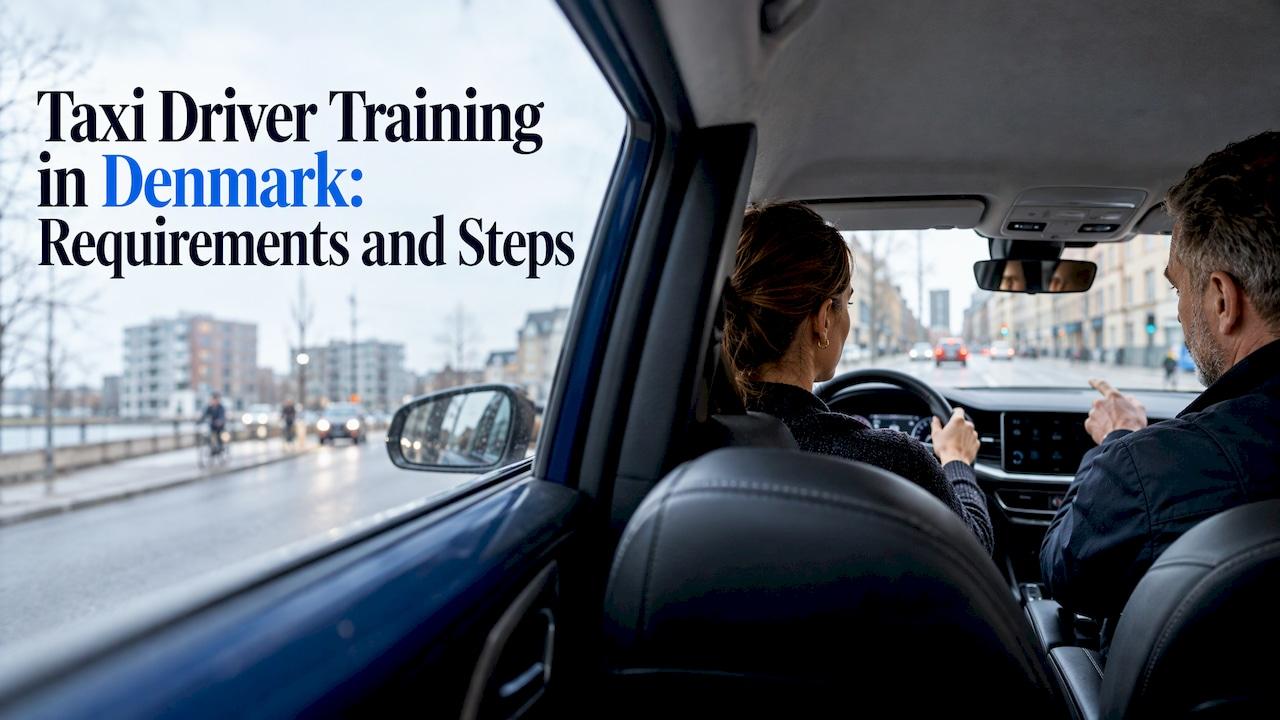
To drive a taxi in Denmark you need a chauffeur card (chaufførkort), and to get one you must complete a course approved by the Danish Road Traffic Authority (Færdselsstyrelsen), pass a written and a practical exam, and meet age, license, health and Danish-language requirements. The route is the same for everyone, so the real work is getting the order right and avoiding the deadlines that force you to start over. We run the approved taxi course at Votra Danmark ApS, and this guide walks you through the whole process, from first check to the card in your wallet.
TL;DR
- You must be 21, have held a category B license for at least 3 years, and speak Danish at the level of Prøve i Dansk 2.
- The course requires at least 74 hours of teaching, including 6 individual driving lessons, and ends with a written exam (Multitest) and a practical exam.
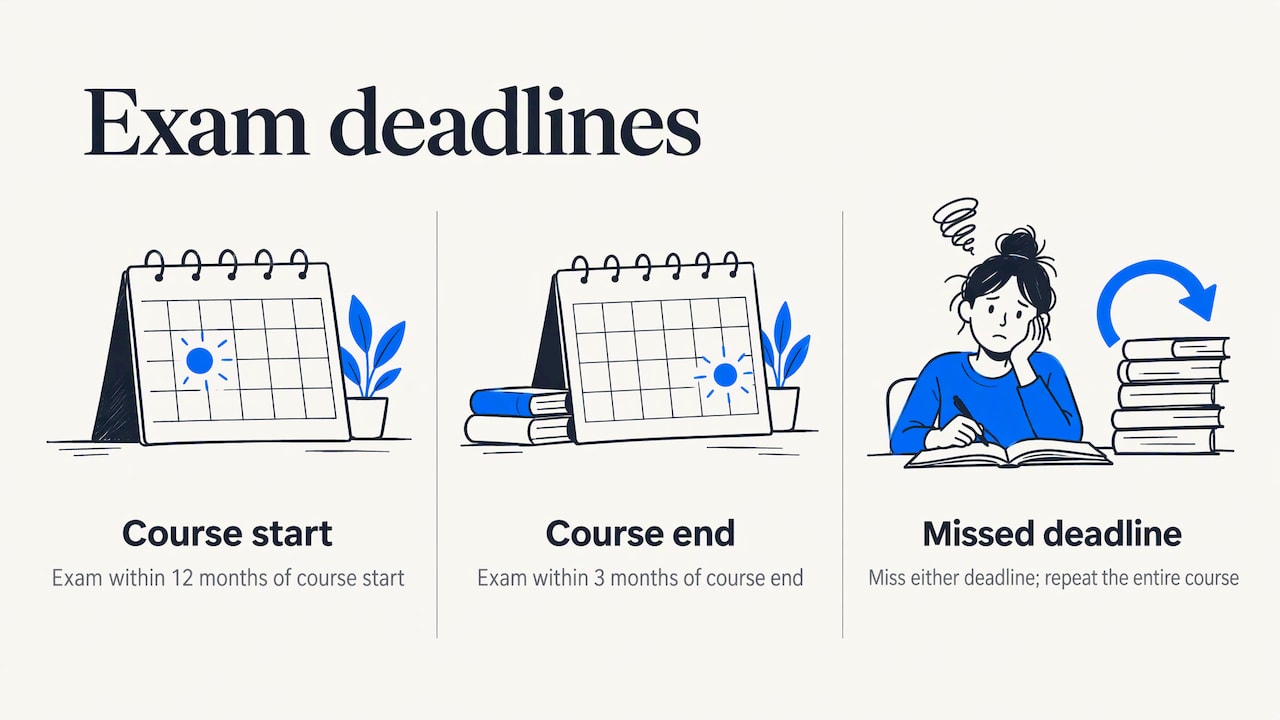
- You must sit the exam within 3 months of finishing the course and within 12 months of starting it, or you repeat the whole course.
- The chauffeur card application fee to the authority is DKK 1,700 (2026 fee schedule). The card is valid for up to 5 years, and the course must have been passed within the last 10 years.
- You can start with our taxi course page.
Table of Contents
- What the law actually requires
- The Danish-language requirement
- What the course covers and how you are assessed
- Step by step: from decision to chauffeur card
- What it costs and who pays
- Planning the timeline
- Renewal and keeping your qualification valid
- What changed recently
- Our perspective
- Ready to start
- FAQ
- Sources
What the law actually requires
The rules sit in the Danish Taxi Act (taxiloven). Under section 7 of the Act, a chauffeur card is required to drive a car for commercial passenger transport. The card is issued to a person who:
- is at least 21 years old, of legal age and not under guardianship;
- has held a category B (ordinary car) license for at least 3 years;
- has no conviction that creates a risk of misusing the card;
- can show they will practice the profession responsibly;
- has completed a course approved by the transport minister, with a passed theory exam and practical exam;
- meets the health requirements.
These conditions are cumulative. Missing one means no card. The Road Traffic Authority adds that the course must have been passed within the last 10 years, and the card itself is issued for up to 5 years. After that you renew it, and the course certificate must still fall within the 10-year window.
The same qualification covers limousine and patient transport driving, not only classic street taxis. If your plan is to work for a taxi company, a limousine operator or a patient transport contractor, this is the one course that opens all three doors.
The 3-year license rule in practice
The three years are counted from when you first held category B, but periods during which your license was revoked do not count. At the first day of the course you must show your valid original B license. If you recently exchanged a foreign license, check the date on which you actually obtained category B, since that is what matters, not the issue date of the Danish card.
The exception for emergency staff
Students on an approved rescue worker or ambulance technician program are exempt from the chauffeur card for public authority transport, provided the course is passed and they carry documentation from their school while driving. This is the only exemption in the Act, and it does not apply to ordinary taxi work.


The Danish-language requirement
This is where most international candidates stall, so check it before you pay for anything. The law requires Danish at the level of the goals for Prøve i Dansk 2 for admission to the course. The Road Traffic Authority says the level can be documented in several ways, including:
- Prøve i Dansk 2 or Prøve i Dansk 3;
- the Danish final exam from lower secondary school (folkeskolens afsluttende prøve);
- FVU-Danish (adult reading and writing education) at step 2 or 3;
- an upper-secondary or higher education taken in Danish.
If you have no document, you can take Prøve i Dansk 2 first. In very special cases the authority can grant a dispensation after an interview, but you should not plan around that. The authority's guide is the place to confirm what counts.
The practical consequence: the teaching, the Multitest exam and the conversations with passengers all happen in Danish. If your Danish is below that level, the fastest route to a taxi job is to raise the language level first, then enroll.
What the course covers and how you are assessed
The Road Traffic Authority's lesson plan requires at least 74 hours of teaching across ten subjects, including 6 individual driving lessons. Only the first-aid hours can be reduced, and only if you have passed the Danish First Aid Council's courses in traffic-related first aid and CPR within the last 12 months. All teaching must be completed before you can sit the written exam.
The ten subjects are laid out in the lesson plan itself. In broad terms, a taxi course teaches you the legal framework for passenger transport, safe and economical driving, customer service, handling difficult situations, and the practical use of the taxi's equipment. Assessment has two parts:
| Part | Format | What it tests |
|---|---|---|
| Written exam | Multitest, taken after all teaching is done | Knowledge of the rules and the subjects in the lesson plan |
| Practical exam | Driving and professional conduct | That you can carry out the job safely and correctly |
Because the course is set by an official lesson plan, every approved school covers the same content. What differs is how well it is organized around your life: class times, how quickly you get driving lessons, and when exam slots open.
Step by step: from decision to chauffeur card
1. Check your eligibility
Confirm your age, your 3 years of category B, your Danish level and your criminal record situation. A conviction that points to a risk of misuse of the card can block the application, so raise any doubt early rather than after you have paid for a course.
2. Enroll at an approved school
According to virk.dk, the first step is to sign up with an approved school that offers the course, and the school decides whether your Danish meets the requirement. The school then submits the chauffeur card application on your behalf. We offer this qualification as Taxa Uddannelse. Our offering is tailored to Danish transport regulation, and it includes online self-paced study options, live exam slots and digital certificates. Our English-language overview is on the taxi driver training page.
3. Complete all teaching
You cannot sit the exam until every hour is done, including the 6 individual driving lessons. Missing a session is the most common reason an exam date slips, and that matters because of the deadlines in step 5.
4. Get the medical certificate
The health certificate must be on the Road Traffic Authority's official form, issued by your own doctor, no more than 3 months old, and sent in a sealed envelope to the authority at Sorsigvej 35, 6760 Ribe. Your doctor checks things like vision and hearing. Book the appointment so that the certificate does not expire before your application is processed: three months passes faster than it sounds if your exam is delayed.
5. Pass the exams inside the deadlines
The authority's guidance of 26 September 2025 says the exam must be taken no later than 3 months after the course ends and no later than 12 months after it started. Miss either deadline and you must take the entire course again. Plan your exam slot before you finish the last lesson.
6. Apply and give consent
You log in with your CPR number and digital ID and consent to the processing of your criminal record and health data, while the school submits the application. The authority's fee for processing an application for issuing, renewing or replacing a chauffeur card is DKK 1,700, under the fee order that took effect on 1 January 2026. Fees are reset by order, so check the current schedule when you apply.
7. Keep the card visible
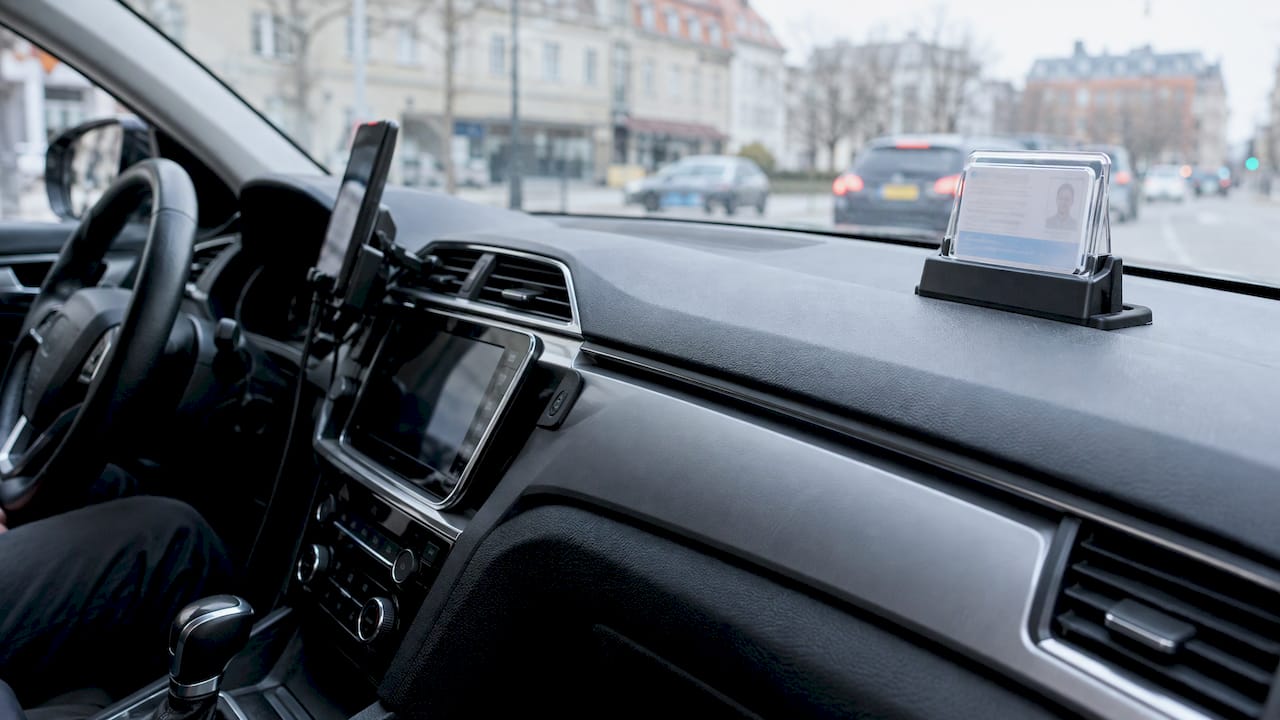
Once issued, the card is valid for up to 5 years. The Act requires you to carry it in the vehicle, and it must be placed so passengers can see it. That visibility is the point: passengers can see you are approved and can identify you if they need to complain.
What it costs and who pays
There are two separate costs. The authority's fee for the chauffeur card is DKK 1,700. The course fee is set by the school, and it is not regulated by the Road Traffic Authority. Our taxi course page is the place to see the current offer, since we do not publish a fixed price in this article.
Some taxi courses are offered as adult vocational training (AMU). The state guidance on those programs explains that each AMU program has a financial framework made up of a per-student subsidy and a participant payment. If you are unemployed, ask your job center or unemployment fund whether your plan qualifies, before you enroll rather than after. We do not promise any grant or subsidy, since that decision is made by the job center or the fund.
Planning the timeline
A realistic plan has four blocks. Verify eligibility and Danish documentation first, because that can take longest. Then book the course and a doctor's appointment so the certificate is fresh when you need it. Next, finish teaching with an exam date already booked. Finally, let the school submit your application and pay the fee. Working backward from the 3-month and 12-month exam deadlines is the single best way to avoid paying twice.
For employers, the same plan applies per driver. If you are training several staff, stagger the start dates so that exam slots do not all fall in the same week, and keep each person's 10-year course date on file.
Renewal and keeping your qualification valid
The card lasts up to 5 years, and the application fee for renewal is the same DKK 1,700 under the 2026 fee order. The course certificate must have been passed within the last 10 years, so if you have been away from the trade for a long time, check that date before you renew. Our offering includes recurring qualification renewal for drivers, and you can see the relevant courses at votra.dk/kurser.
What changed recently
The Taxi Act in its consolidated version of 17 September 2024 was amended by an act of 25 March 2025, and the current fee order replaced the previous one from 1 January 2026, according to the official consolidated text. What applies today: a 10-year window for the course, up to 5 years of card validity, the Prøve i Dansk 2 language requirement and the 74-hour lesson plan. Rules like these can be amended, so confirm the details with the Road Traffic Authority before you pay.
Our perspective
Most people who struggle with the taxi qualification do not fail the exam. They fail the logistics: a doctor's certificate that expires, an exam that falls outside the 3-month window, or a language document that nobody checked at the start.
That is why we build our offering around the Danish regulatory requirements for the transport sector, with online self-paced study, live exam slots and digital certificates. The aim is simple: you finish the teaching, you sit the exam while the deadlines are still on your side, and you hold your certificate in digital form when the authority needs it.
For people who want to go further, taxi driving is often a first step. Some drivers later want to run their own transport company, and for that we also have Votra Business ApS, which supports transport companies with company formation, bookkeeping, payroll and document monitoring.
Jamal Mahjoub
Ready to start
If you meet the age, license and language requirements, the next step is to enroll in the approved course. Our Taxa Uddannelse is built for the Danish rules, with online self-paced options, live exam slots and digital certificates. If your plan includes driving vans as well, see our van driver qualification, and if you want to start your own company afterward, our business start-up service is the place to begin.

FAQ
How long does it take to become a taxi driver in Denmark?
The course requires at least 74 hours of teaching, including 6 individual driving lessons, so it is a matter of weeks rather than days. You then need to pass the written and practical exams within 3 months of finishing and within 12 months of starting. Add time for the doctor's certificate and the authority's processing of your application.
Do I need to speak Danish?
Yes. Admission to the course requires Danish at the level of Prøve i Dansk 2. You can document it with several certificates, for example Prøve i Dansk 2 or 3, the lower-secondary final exam in Danish, or FVU-Danish at step 2 or 3. Without documentation, you can take Prøve i Dansk 2 first.
Can I drive a taxi with a foreign license?
The Taxi Act requires a category B license held for at least 3 years, and you must show a valid original B license when you start the course. Periods when your license was revoked do not count. If your license comes from another country, ask the school or the Road Traffic Authority how your category B history will be counted.
How long is the chauffeur card valid?
The card is issued for up to 5 years and must be carried in the vehicle where passengers can see it. Your course must have been passed within the last 10 years. Renewing the card costs the same DKK 1,700 application fee under the 2026 fee order.
What happens if I miss the exam deadline?
If you do not sit the exam within 3 months of finishing the course, or within 12 months of starting it, you must take the whole course again. That is why it is wise to book your exam slot before the last lesson.
Sources
- Consolidated Taxi Act (Bekendtgørelse af taxiloven), Retsinformation
- Sådan bliver du chauffør, Færdselsstyrelsen
- Taxibekendtgørelsen § 24, admission requirements, Lovguiden
- Taxi kvalifikationsuddannelse lesson plan, Færdselsstyrelsen
- How to apply for a Danish chauffeur license, Virk.dk
- Guidance on the qualification order, 26 September 2025, Færdselsstyrelsen
- Fee order no. 1596 of 11 December 2025, Retsinformation
- Guidance on AMU provision, Retsinformation