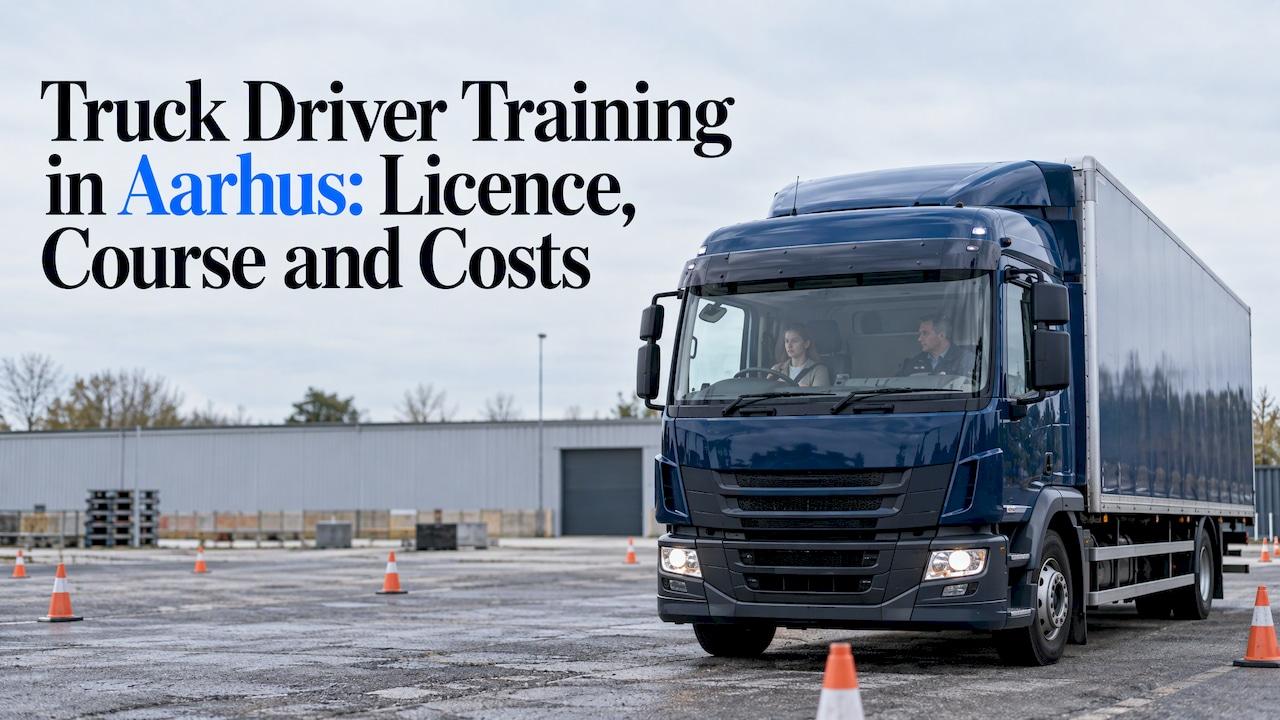
To work as a professional truck driver in Aarhus, you need two things: the right driving licence category and a Danish driver qualification certificate, both obtained at a training centre approved by the Danish Road Traffic Authority. The standard public route is a 30-day course that leads to category C. If your goal is to own the truck and run the business rather than drive for someone else, the next step is a haulier course, and that is where we at Votra come in with Vognmand til Lastbil.
This guide explains what the licence route looks like in Aarhus, what it costs, how the exams work, who can get help paying, and how the driver path connects to becoming a haulier (in Danish: vognmand).
TL;DR
- Category C (large truck) is the licence most truck jobs require. Under the professional-qualification rules you can start at 18, otherwise the normal minimum age is 21.
- The public AMU course (a state-funded adult vocational course) for truck goods transport runs 30 course days, and participants pay 214 DKK per day according to UddannelsesGuiden.
- Only centres approved by the Danish Road Traffic Authority (Færdselsstyrelsen) may offer the qualification and its exams.
- If you want to run your own haulage company, our Vognmand til Lastbil course costs 14,900–16,900 DKK as a one-off price.
Table of Contents
- Which licence and qualification you need
- The AMU course in Aarhus: 30 days to category C
- Check that the centre is approved
- Funding: unemployed, job centres and employers
- Two careers from one starting point: driver or haulier
- A worked example: from job seeker to own truck
- Keeping the business side in order
- Our offer for haulier-minded drivers
- Our perspective
- FAQ
- Sources
Which licence and qualification you need
Before you pick a course in Aarhus, decide what kind of truck you want to drive. Danish licence categories are defined by vehicle weight. According to the Danish licence regulation, category C1 covers a truck above 3,500 kg and up to 7,500 kg, and category C covers a large truck. The "E" versions, C1/E and C/E, add a heavy trailer to the corresponding truck category. Articulated lorries and most long-haul work require C/E.
Age matters. Færdselsstyrelsen's category table says C1 and C1/E can be obtained from age 18, while C and C/E ordinarily require age 21. There is a route for younger drivers: the licence regulation allows category C from age 18 when it is taken as part of the statutory professional-qualification programme, and until age 21 the licence is limited by the professional-driver rules.
The second piece is the qualification itself. For professional road transport with vehicles that need C1, C1/E, C or C/E, the Danish qualification regulation requires a driver-training certificate that proves either an initial qualification or periodic training. In plain terms: a licence lets you drive the truck, and the certificate lets you do it as a job. Employers will ask for both.
The regulation also allows goods transport with C and C/E from age 18 for holders of the completed basic qualification certificate. If you are 18 to 20 and want to start early, this is the route to ask a training centre about.
The AMU course in Aarhus: 30 days to category C
The most direct way into truck driving for adults is the AMU course (arbejdsmarkedsuddannelse) for goods transport with a truck. UddannelsesGuiden, the Danish government's education portal, lists it as a 30-day course with normally no admission requirement. It is aimed at people who want a job driving goods by truck, and participants acquire category C when they complete it.
The cost is modest compared with a private licence. UG lists a participant payment of 214 DKK per day. For 30 days that is 6,420 DKK (30 × 214) in participant payment. Some participants can also receive compensation for lost income, called VEU compensation, depending on their situation. Check the details on the UG page for your own case.
A second route is the vocational EUD programme (erhvervsuddannelse) at a technical college. UG gives its normal length as three years after the GF2 stage, or about three years and six months for students who come directly from school. This suits young people who want a full vocational education in transport rather than a quick licence.
How the exams work
For the intensive basic qualification, Færdselsstyrelsen's guidance from September 26, 2025 describes four weeks at an approved training centre. It ends with a 45-minute multiple-choice written test and, for goods transport, a practical test.
The qualification regulation sets the minimum content. The basic programme is at least 296 hours, including 20 individual driving hours and 11 hours of first-aid instruction. The intensive basic programme is at least 148 hours, including 10 individual driving hours and 11 hours of first-aid instruction. Both end with a written test and, for goods transport, a practical load-securing test. The figures are in the qualification regulation, so confirm the current hours with the centre you choose.

The practical test is not just a drive. Load securing means showing you can strap and block cargo so it stays put under braking and cornering. That is where many first-time candidates lose points, so ask for extra practice on it.

Rules changed in 2026
Driving education in Denmark was reworked this year. Færdselsstyrelsen describes a modernised driving education that took effect on July 1, 2026 and applies to all licence categories, with greater flexibility and better feedback. The regulation on driving education and tests was also amended in June 2026, per the regulation record. If a guide or a friend describes the process from before mid-2026, check it against the agency's current page.
Check that the centre is approved
Any course that issues a qualification must be delivered by the right kind of centre. Færdselsstyrelsen states that training and exams for initial qualifications and periodic training may only be offered with the agency's approval, and that it supervises approved training centres and test locations.
So before you pay, confirm the following:
- The centre is approved by Færdselsstyrelsen for the qualification you want.
- The course includes the licence category you need (C, C/E) and not just theory.
- The exam dates fit your timeline, since waiting for a slot is the most common cause of delay.
- Course language and materials suit you. Many courses are taught in Danish only.
Aarhus has several types of providers: public AMU centres, technical colleges and private driving schools. Their prices and calendars differ. Use UG's course search for current dates and places, because schedules change every term.
Funding: unemployed, job centres and employers
If you are unemployed, the first call is your job centre or your unemployment insurance fund (a-kasse). Ask whether the AMU truck course can be part of your job plan, and whether your case allows VEU compensation or other support. Eligibility depends on your personal situation and local decisions, so get an answer from the job centre in writing before you enroll.
Employers can arrange training for employees too. A company that hires drivers without the qualification should plan for the course days, the exam, and the period when the employee is away from work. The same applies to periodic training, which keeps a qualification valid for those already driving professionally.
Two careers from one starting point: driver or haulier
Many people begin as drivers and later want to run their own truck. In Denmark, operating a haulage business for hire requires a separate qualification, the haulier education. It is not the same as a driving licence. A driving course teaches you to drive and secure a load. A haulier course teaches you to run a transport company: rules, economy, and the legal requirements of the business.
That is the course we run. Our Vognmand til Lastbil is a haulier course for truck operators, priced at 14,900–16,900 DKK one-off. We also run Vognmand til Varebil for van operators at 6,900–8,900 DKK one-off. If you prefer to read about the courses in English, see our pages for the truck haulier course and the van haulier course.
Our courses are built around the regulatory requirements of the Danish transport sector. They are offered in several languages, with online self-paced study, live exam slots and digital certificates. That matters if you work irregular hours behind the wheel, because you can study between routes rather than taking weeks off.
If your focus is vans rather than trucks
Van work does not need category C. Drivers of vans with professional qualification requirements follow a separate track. Our Varebil Grunduddannelse (VB GU) covers the initial qualification, and our Varebil Efteruddannelse (VB EU) covers the periodic training. English pages are available for the van driver qualification and the van driver refresher course. We have not published prices for these courses, so use the course pages for details.


A worked example: from job seeker to own truck
Take a 27-year-old job seeker in Aarhus with a car licence and no transport experience. A realistic plan looks like this:
- Job centre meeting. Ask about the AMU truck course and compensation options.
- AMU course. Thirty course days at an approved centre. At the participant rate of 214 DKK per day, the participant payment totals 6,420 DKK, before any compensation.
- Exams. The written multiple-choice test and the practical load-securing test.
- First job. Drive for a haulier for a year or two and learn the routes, customers and margins.
- Haulier course. When you are ready to run your own vehicle, take the haulier education.
- Company set-up. Register the company and put bookkeeping, VAT and payroll in place from the first invoice.
Steps 5 and 6 are where we help. The first four are the public route described above.
Keeping the business side in order
Drivers who become hauliers often find the paperwork harder than the driving. VAT returns, invoices that customers pay late, driver wages and documents with expiry dates all land on one person. Votra Business works as an external operations and finance department for haulage firms. Our services cover company formation, bookkeeping, VAT, payroll, invoicing, debtor follow-up, an overview of the economy, administrative fleet management, and monitoring of driver documents and deadlines. You can start with company formation through Virksomhedsopstart and see the plans on the Votra Business page.
The document monitoring is the part owners tend to value. A driver whose qualification certificate or licence has lapsed cannot legally drive for you, and a missed date can stop a truck. Keeping those deadlines in one place is a routine task, and we take it off your hands.
Our offer for haulier-minded drivers
If you plan to move from the driver's seat to the owner's seat, start with our haulier course. It is one-off priced, available with online self-study and a live exam slot, and it gives you a digital certificate. Votra Danmark ApS delivers the courses, and Votra Business ApS handles the company side afterwards, so you deal with one brand for both steps.

See the Vognmand til Lastbil course or browse all Votra courses.
Our perspective
Most people who ask about truck training in Aarhus are asking about a licence. That is the right first question, and the approved public route answers it well. The second question usually comes a year or two later: what would it take to run my own truck?
That is where we see drivers get stuck, not on the driving but on the rules and the paperwork around a transport company. Our haulier courses are designed around the Danish regulatory requirements, with self-paced online study and live exam slots, so a working driver can prepare without giving up income for weeks.
Once the company exists, the work shifts to bookkeeping, VAT, payroll and deadlines. We built Votra Business so a new haulier can hand those over and keep their time for customers and routes. Training and operations under one brand is the idea: you learn the business, and then you run it with support.
Jamal Mahjoub
FAQ
How long does truck driver training in Aarhus take?
The AMU course for goods transport by truck is 30 course days, according to UddannelsesGuiden. The intensive basic qualification route is described as four weeks at an approved centre. A technical college EUD programme takes about three to three and a half years.
How old do I have to be to drive a truck professionally?
Category C1 can be obtained from age 18, while C and C/E ordinarily require 21. At 18 you can drive category C if you take it as part of the statutory professional-qualification programme, with limits until you turn 21.
Do I need to speak Danish?
Most public truck courses and exams are held in Danish, so ask each centre about language options before you enroll. Our haulier and van courses are offered in several languages, and English pages are available at votra.dk/en.
Is a truck driver course the same as a haulier course?
No. A driver course gives you the licence and qualification to drive. A haulier course qualifies you to run a transport company. Our Vognmand til Lastbil course is the haulier course, priced at 14,900–16,900 DKK one-off.
Can I get help paying for the course?
UG lists a participant payment of 214 DKK per day for the AMU truck course and mentions possible VEU compensation. If you are unemployed, ask your job centre or a-kasse before enrolling, since it depends on your case.
Sources
- UddannelsesGuiden: Godstransport med lastbil (AMU)
- Færdselsstyrelsen: Kørekortkategorier
- Bekendtgørelse om kørekort (Retsinformation)
- Bekendtgørelse om kvalifikationskrav til visse førere (Retsinformation)
- Færdselsstyrelsen: Vejledning til kvalifikationsbekendtgørelsen, 26 September 2025
- Færdselsstyrelsen: Moderniseret køreuddannelse
- Bekendtgørelse om køreuddannelser og køreprøver (Retsinformation)
- Færdselsstyrelsen: Godkendelse af uddannelsessted